
For a long time, the word “luxury” in real estate has meant more: more marble, more square footage, more air-conditioned lobbies, more lights left on in more empty corridors. The word “sustainable,” meanwhile, has tended to mean less: less water, less energy, less waste, less indulgence. Put the two side by side and they can look like opposites - one an invitation to consume, the other a request to hold back.
But that framing says more about how both words have been marketed than about what they actually mean. Ask a buyer today what makes a home feel genuinely luxurious, and the answers that come up most often are surprisingly quiet ones: space to breathe, clean air, privacy, silence at night, trees outside the window, water that doesn't run out in April. These are not extravagances. They are, almost word for word, the things that sustainable planning is built to protect.
This article looks at where luxury and sustainability genuinely overlap, where they honestly pull in different directions, how to tell real sustainable planning from marketing language, and what a buyer in Bangalore should look for if they want a home that offers both.
Why the Two Have Seemed Like Opposites
The tension is not imaginary. Much of the luxury housing built over the last few decades did lean on excess: oversized homes, heavy reliance on air-conditioning, imported finishes shipped across continents, manicured lawns that demand constant watering, and amenity blocks lit and cooled whether anyone was using them or not. In that model, luxury was something you could measure by how much a development consumed.
Sustainability, by contrast, has often been communicated through its sacrifices like shorter showers, dimmer lights, smaller footprints. Framed that way, it's easy to see why many buyers assumed that choosing a sustainable home meant accepting a compromise on comfort or prestige.
Both assumptions are increasingly out of date. The most thoughtfully planned premium communities today treat sustainability not as a restriction layered on top of luxury, but as one of the things that makes the luxury last such as a home that stays cool without running the AC all day, a community whose water supply doesn't depend entirely on tankers, a neighbourhood whose tree cover is mature rather than newly planted and struggling.
What Luxury Actually Means to Buyers Now
If you look at what buyers in the premium segment actually ask for, the list has shifted noticeably. Brass fittings and double-height lobbies still have their place, but the conversation increasingly centres on a different set of qualities:
- Space - not just a large built-up area, but room around the home: a garden, a setback from the road, a view that isn't another building's wall.
- Privacy and quiet - lower density, fewer shared walls, and a setting where you can hear birds rather than traffic.
- Clean air and greenery - especially for families with children or ageing parents, in a city where heat, dust and congestion have become daily concerns.
- Reliability of basics - water, power and drainage that work consistently, which is a quiet but very real form of luxury in a rapidly growing city.
- Time and wellbeing - the ability to step outside for a walk, a cycle ride or a game of badminton without planning a trip across the city to do it.
Notice how many of these overlap with the goals of sustainable planning. A low-density layout with generous open space is both a premium feature and an environmentally lighter one. A mature tree canopy is both a beauty and a cooling system. A community that manages its own water well is both resilient and, in practical terms, more comfortable to live in.
What Sustainable Real Estate Actually Means
“Sustainable” is one of the most over-used words in property marketing, so it helps to be specific about what it can legitimately cover. In a residential community, genuine sustainability tends to come down to a handful of concrete areas:
- Water - how the community collects, uses, treats and reuses water, including rainwater harvesting, wastewater treatment and the choice of landscaping that doesn't demand constant irrigation.
- Green cover - how much of the land is left open and planted, what is planted (native species versus decorative ones), and whether existing trees were protected during construction or cleared and replaced.
- Energy - how efficiently common areas are lit and cooled, whether solar is used for shared infrastructure, and how well the layout supports natural light and ventilation.
- Waste - whether there is a working system for segregating, composting and recycling, rather than simply a bin at the gate.
- Density and land use - how many homes are packed into how much land, and how much of that land remains genuinely open.
- Materials and construction practice - what the community is built from and how, including how much construction waste and disturbance the site generates.
The important point is that these are things a buyer can ask about and verify. A community either has a working sewage treatment plant or it doesn’t. It either retained its mature trees or it didn’t. Sustainability stops being a slogan the moment you start asking for specifics.
Where Luxury and Sustainability Genuinely Align
There are several places where the two goals don't merely coexist but actively reinforce each other.
Low density: A community planned around larger plots and generous open space naturally carries a lighter load per acre, fewer people sharing the same water, road and drainage infrastructure, more soil to absorb rainfall, more room for trees to grow to full size. At the same time, low density is exactly what many premium buyers are paying for: privacy, breathing room, and a sense that the neighbourhood hasn't been squeezed to maximise unit count.
Mature green cover: Trees are perhaps the clearest example. A well-established canopy lowers ambient temperature, improves air quality, supports birds and pollinators and softens noise. It is also one of the most visible markers of a premium address and one of the few features that money alone cannot create quickly, because a tree takes years to grow. A development that protects existing greenery rather than starting from bare earth is offering something that cannot be copied overnight.
Natural light and ventilation: Homes designed to catch daylight and cross-breezes feel more pleasant and cost less to run. For a buyer building on their own plot, this is where orientation, window placement, deep verandahs and cross-ventilation can reduce reliance on mechanical cooling and make the home feel more open and comfortable at the same time.
Water security: In much of Bangalore, water has become one of the defining concerns of urban living, with recent summers putting real strain on borewells and tanker supply in many neighbourhoods. A community that harvests rainwater, treats and reuses wastewater and plants sensibly is not just being responsible; it is offering residents a more dependable daily life, which is precisely what luxury is supposed to deliver.
Where the Two Honestly Pull Apart
It would be dishonest to claim there are no tensions at all, and a credible article on this subject should name them.
- Size and footprint: A larger home inevitably uses more materials and more energy than a smaller one, however well designed. Spacious living and a minimal footprint are not perfectly compatible, and the honest answer is to build thoughtfully rather than to pretend the trade-off isn't there.
- Amenities: A large clubhouse, pool or gym consumes energy and water to operate. The question is not whether such amenities should exist — many residents value them — but how efficiently they are designed and run, and whether they are actually used.
- Location and travel: A community set in greener, quieter surroundings can mean longer drives for some daily needs, and transport is a significant part of any household's environmental footprint. Better connectivity and nearby social infrastructure help, but it remains a real consideration.
- Cost: Some sustainable features, such as treatment plants and well-designed drainage, cost more upfront. These costs are real, and a buyer is right to ask what they are paying for and how it is maintained over time.
The sensible response to each of these is design rather than denial: building a smaller footprint than the plot allows, specifying efficient equipment for shared facilities, locating communities where daily errands are reasonably close, and being transparent about what systems cost to run.
Acknowledging these tensions doesn't weaken the case for sustainable luxury. It strengthens it, because it shifts the question from “is this development perfect?” to “is this development making sensible, verifiable choices?”, which is a question a buyer can actually answer.
What a Sustainable Premium Community Looks Like in Practice
If you are evaluating a premium plotted community and want to know whether its sustainability claims hold up, these are the areas worth looking at on a site visit and in conversation with the developer:
- Rainwater harvesting built into the layout, with clear information on how it is designed and maintained
- A sewage treatment plant, with treated water reused for landscaping or flushing rather than discharged
- Native and well-suited tree species, along with evidence that mature existing trees were retained
- Energy-efficient common-area lighting, and solar or other renewable sources where practical
- A functioning waste segregation and composting system, rather than a promise of one
- Wide internal roads with pedestrian-friendly paths, shade and walkable open spaces
- A generous share of land kept open and green, visible on the approved layout plan rather than only in the brochure
None of these are exotic. What matters is whether they have been planned in from the beginning, rather than added later as a marketing afterthought. Retrofitting a treatment plant or a drainage network into a finished layout is difficult and expensive, which is why the best indicator of genuine commitment is that these systems appear in the original approved plan, not in a later press release.
Why Plot Buyers Have a Particular Advantage
One of the quieter benefits of buying a residential plot rather than a finished apartment or villa is that the sustainability of your own home is largely in your hands. When you design and build your own house, you decide the orientation, the window placement, the roof design, the materials and the systems.
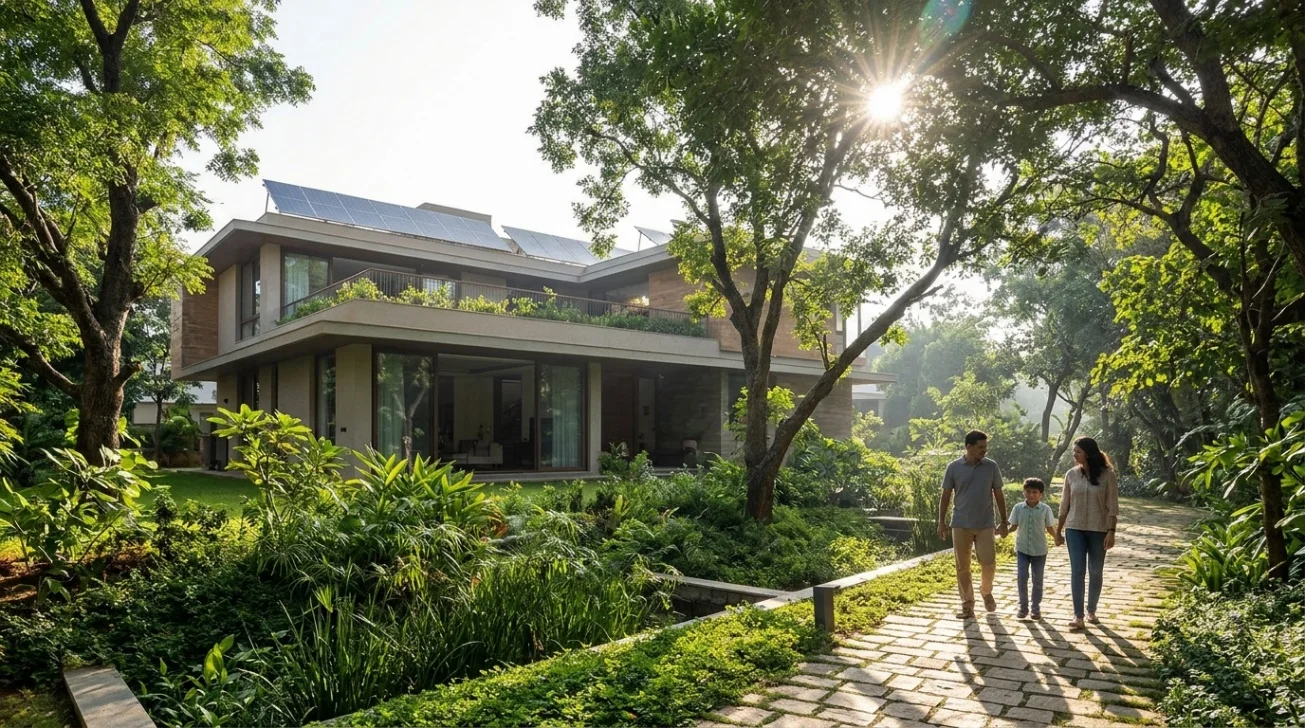
That opens up choices that are very hard to retrofit later: positioning living spaces to catch the morning light, shading west-facing walls against afternoon heat, adding cross-ventilation, planning a rooftop for solar panels, building in a rainwater collection tank, choosing locally sourced materials, and leaving room for trees and a kitchen garden. A well-designed home on a good plot can feel more luxurious and cost less to run than a larger, more heavily air-conditioned one, simply because it has been designed around its setting rather than despite it.
For buyers who care about both comfort and responsibility, this is one of the strongest practical arguments for plotted living: you are not inheriting someone else's design decisions, you are making your own.
What It Feels Like in Everyday Life
It's easy to talk about sustainability in abstract terms - litres, kilowatts, percentages - and lose sight of what it actually changes about daily life. The difference tends to show up in small, ordinary moments rather than in grand features.
It's the evening walk under mature trees rather than along a hot, shadeless road. It's the garden that stays green without a daily battle against the water bill. It's the house that stays noticeably cooler through a Bangalore summer afternoon because the roof is shaded, the walls are well oriented and the breeze has somewhere to go. It's the quiet of a street where traffic is slow and children can cycle without constant worry.
None of these moments appear in a specification sheet, but they are, in practice, what most people mean when they say a place feels premium. They are also the moments that sustainable planning protects, which is the strongest argument that the two ideas belong together: the same decisions that reduce a community's environmental load tend to improve how it feels to live there.
How to Spot Greenwashing
Because sustainability sells, vague green language has become common in real estate marketing. A few simple habits help separate substance from slogan:
- Ask for specifics. “Eco-friendly” and “green living” mean nothing without detail. How many litres of rainwater can the system collect? What capacity is the treatment plant? What percentage of the land is open space?
- Look for it on the ground. Walk the site. Are the trees real and established, or are the brochure's trees still saplings in plastic? Is the drainage visible and well-planned?
- Check the layout plan, not just the render. The approved plan shows what is legally committed. A render shows what a designer imagined.
- Ask about maintenance. A treatment plant or harvesting system that isn't maintained is as good as no system at all. Ask who operates it and how it is funded.
- Be wary of absolutes. No development is perfectly sustainable. Honest developers talk about what they have done and what they are still improving, rather than making sweeping claims.
Why This Matters Especially in Bangalore
Bangalore was once known as the Garden City, and its lakes, tree-lined avenues and mild climate were a large part of its appeal. Rapid growth has put pressure on all three. Lakes have shrunk or disappeared, tree cover has thinned in many areas, and summers have felt hotter in neighbourhoods dominated by
This gives sustainable planning a particular weight here. For a buyer, the practical question is whether the place they are choosing will still be pleasant in twenty years – whether the water will last, whether the tress will have grown rather than been cut, whether the neighbourhood will still feel like somewhere you want to live. Communities planned with those questions in mind are not just doing something admirable; they are protecting the long-term value of the homes within them.
The Bottom Line
Luxury and sustainability only look like opposites if luxury is defined as excess. Once luxury is understood the way many buyers now understand it, as space, quiet, clean air, reliable basics and a connection to nature, the two goals start to point in the same direction.
They do not align perfectly. Larger homes use more resources, amenities cost energy and water, and some compromises are unavoidable. But the most useful question for a buyer is not whether a community is flawless, it is whether its choices are real, specific and verifiable. A development that protects its trees, treats and reuses its water, keeps density low and plans its open space deliberately is offering a form of luxury that is built to last, rather than one that quietly depends on resources that may not.
Choosing a Community That Gets the Balance Right
The most reassuring sign in any premium development is not the length of its amenity list, but the care visible in how the land itself has been planned: where the open spaces sit, how the trees are treated, how water is handled, how much room each home is given to breathe.
Amidst Nature, in Kaggalipura along Kanakapura Road, is planned as a nature-first villa plot community spread across 18 acres, with a 25,000 sq. ft. clubhouse and over 30 amenities. For buyers who want space, greenery and a home they can design on their own terms, it is worth visiting in person and asking the questions listed above - the best way to judge any community's approach to luxury and sustainability is to see it on the ground.
This article is for general informational purposes and does not constitute investment or professional advice. Prospective buyers should independently verify project features, approvals and specifications before making a purchase decision.