


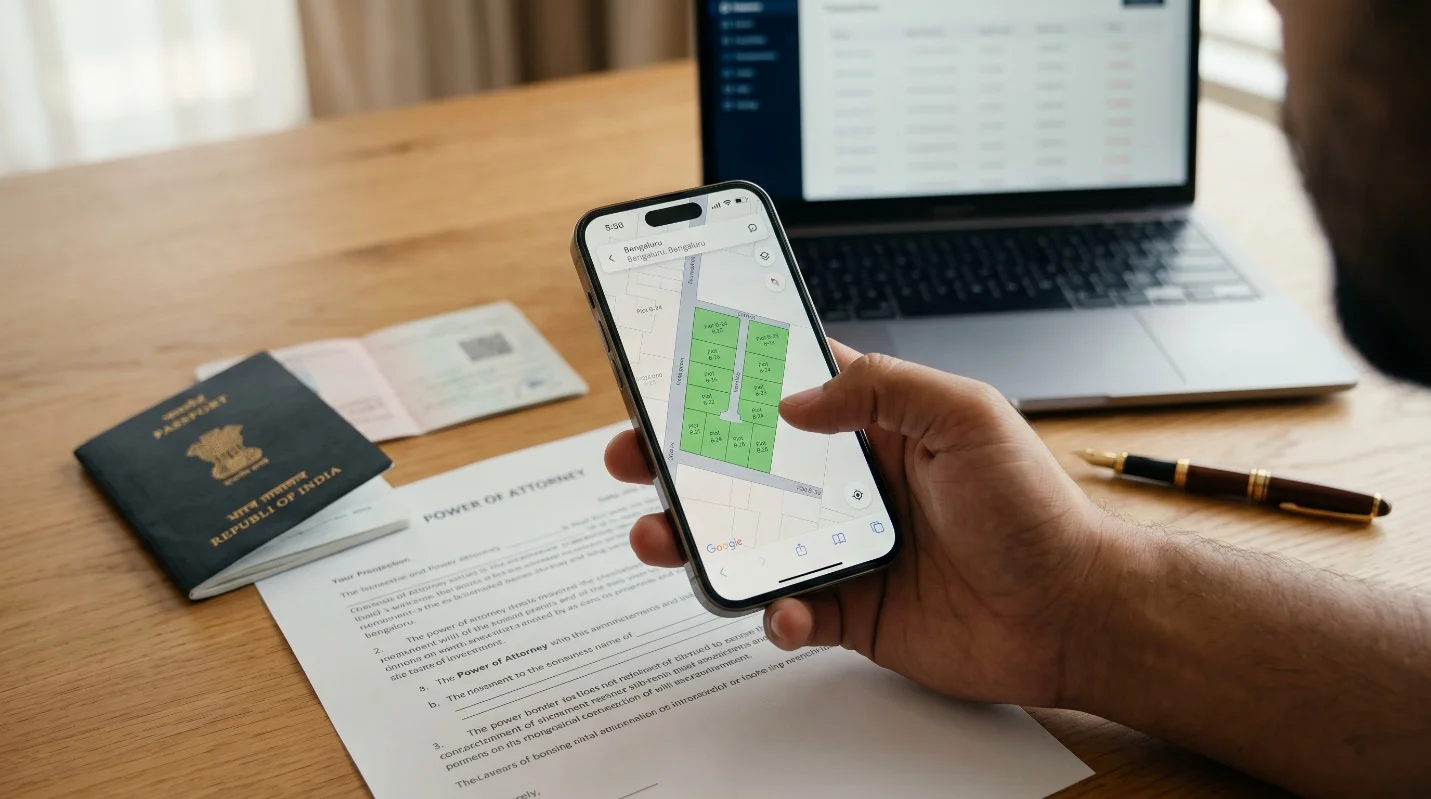
Buying property in India from thousands of miles away sounds complicated - and for a long time, it was. Between power of attorney paperwork, banking rules, and the fear of getting scammed on a deal you can't personally inspect, many NRIs put off land investment in India far longer than they'd like to.
The good news: buying land in Bengaluru as an NRI is entirely legal, well-established, and - with the right process - no risky than buying in person. Thousands of NRIs complete these transactions every year, and the process has become significantly smoother with digital verification, online banking, and developers who now specialize in remote-buyer support.
This guide walks through everything you need to know - eligibility, the step-by-step buying process, banking and tax rules, due diligence, and the mistakes to avoid - so you can approach the purchase with the same confidence as someone buying down the street.
Can NRIs Legally Buy Land in India?
Yes. Under the Foreign Exchange Management Act (FEMA), NRIs and OCI cardholders are permitted to purchase residential and commercial property in India without seeking special permission from the Reserve Bank of India. This isn't a gray area or a workaround - it's a well-established, RBI-regulated pathway that banks, developers, and registrars deal with routinely.
There's one important exception: agricultural land, farmhouses, and plantation property cannot be purchased by NRIs or OCIs - these can only be inherited or received as a gift. This matters more than people realize, because some "plots" advertised in and around Bengaluru are technically converted agricultural land, and conversion status isn't always obvious from a listing or a broker's pitch. Always confirm a plot's conversion certificate before assuming it qualifies for purchase.
Residential plots in approved, BMRDA-sanctioned layouts - the kind most NRIs are looking at when they consider Bengaluru - fall squarely within what NRIs can legally buy, with no cap on the number of properties or special approval process required.
Understanding NRI, OCI, and PIO Status
The rules differ slightly depending on your exact status, so it's worth being precise:
- NRI (Non-Resident Indian) - an Indian citizen residing outside India for employment, business, or any other purpose indicating an intention to stay abroad for an uncertain duration.
- OCI (Overseas Citizen of India) - a foreign citizen of Indian origin granted OCI status, which carries most of the same property rights as an NRI, including the ability to buy residential and commercial property.
- PIO (Person of Indian Origin) - largely merged into the OCI scheme since 2015, but older PIO cardholders should confirm their card's validity and whether it needs to be converted to OCI status for a smooth transaction.
If you're unsure which category you fall into, this is worth clarifying with your lawyer before you begin - it affects which documents you'll be asked for at registration.
How the Remote Buying Process Works
You don't need to be in India to buy land here. Two mechanisms make that possible, and understanding both well will save you a lot of back-and-forth later.
Power of Attorney (POA)
A POA lets you authorize a trusted person - a family member, friend, or lawyer - to sign documents, complete registration, and take possession on your behalf. Not all POAs are equal, and getting this document right is arguably the single most important step in a remote purchase.
- Specific vs. General POA - A Specific Power of Attorney, limited to the exact transaction (naming the property, the parties, and the scope of authority), is strongly preferable to a broad General POA. It limits your representative's authority to exactly what's needed and reduces risk if the relationship ever sours.
- Notarization and attestation - The POA needs to be notarized and attested at the Indian consulate or embassy in your country of residence. Depending on the country, it may instead need an apostille under the Hague Convention - your consulate can confirm which applies.
- Registration in India - Once executed abroad, the POA typically needs to be stamped and, in many cases, registered in India within a defined window (commonly three to four months) for it to be usable in a registration transaction. Missing this window is a common and entirely avoidable delay.
- Choosing your POA holder carefully - Because this person will be signing on your behalf, choose someone you trust completely, and consider involving your lawyer as a co-signatory or at least a reviewing party on major steps, even if they aren't the POA holder themselves.
Video KYC and Digital Verification
Most developers and banks now offer video-based KYC, letting you complete identity verification without a branch visit. Combined with courier-based document exchange and e-signatures where permitted, the entire process - from booking to final registration - can often be completed without you setting foot in India, provided your POA holder is reliable and the developer's process is transparent.
A Step-by-Step Timeline of an NRI Land Purchase
Having a rough sense of sequence helps set expectations, since NRI transactions typically take slightly longer than resident purchases due to document courier times and consulate scheduling. A typical timeline looks like this:
- Shortlisting and virtual due diligence - Research the developer, project, and location; request layout approvals, EC, and Khata documentation digitally.
- Booking and token payment - A booking amount is paid, usually via NRE/NRO wire transfer, to hold the plot.
- Drafting and executing the POA (if you won't be present) - This runs in parallel with document review and can take two to four weeks depending on your country's consulate processing times.
- Sale agreement execution - The Agreement to Sell is signed, outlining payment schedule, possession terms, and any conditions.
- Final payment and registration - Payment is completed through banking channels, and the sale deed is registered at the local Sub-Registrar's office - either by you in person or your POA holder.
- Khata transfer and possession - Property is transferred to your name in municipal/BMRDA records, and possession is formally handed over.
Depending on the developer's process and your document readiness, this entire cycle can run anywhere from four to twelve weeks.
Payments: What You Need to Know
All payments must route through proper banking channels - cash transactions are not permitted for NRI property purchases and can create serious legal and tax complications later. Funds typically move through one of the following:
- NRE (Non-Resident External) accounts - for funds earned abroad; principal and interest are fully repatriable.
- NRO (Non-Resident Ordinary) accounts - for funds with an Indian income source (rent, dividends, etc.); repatriation is subject to limits and documentation.
- FCNR (Foreign Currency Non-Resident) accounts - held in foreign currency, sometimes used for larger transactions to avoid currency conversion timing risk.
- Direct inward remittance through normal banking channels from your overseas account.
Repatriation Rules
If you plan to sell the property in the future and move proceeds back abroad, FEMA allows repatriation of sale proceeds for up to two residential properties, subject to the original purchase having been funded through proper NRE/FCNR channels or inward remittance - not entirely through NRO funds sourced within India. Repatriation is also generally capped at USD 1 million per financial year, and requires Form 15CA/15CB certification from a chartered accountant confirming taxes have been paid.
This area is genuinely worth a dedicated conversation with a chartered accountant or FEMA-specialist lawyer before you transact. The rules depend on your funding source, how long you've held the property, and your residency status at the time of sale - not something to guess at or assume based on a friend's experience in a different country.
Tax Implications for NRIs
Tax treatment is one of the most commonly misunderstood parts of NRI property investment, so it deserves its own section.
- TDS on purchase - If you're buying from a resident seller and the transaction value exceeds ₹50 lakh, TDS (Tax Deducted at Source) applies at 1%, deducted by the buyer and deposited with the tax authorities. If you are the seller and the buyer is a resident, TDS rates on NRI sellers are considerably higher (commonly in the 20%+ range before applicable surcharge), which is an important consideration if you're thinking of this as a mid-term investment rather than a long hold.
- Capital gains tax - Gains on sale are classified as short-term or long-term depending on the holding period, with long-term gains (typically over two years for immovable property) taxed at a more favorable rate with indexation benefits.
- Double Taxation Avoidance Agreement (DTAA) - India has DTAA treaties with most countries with large NRI populations (UAE, UK, US, Singapore, and others), which can reduce or offset tax paid in both jurisdictions. The specifics vary significantly by country, so this is worth reviewing with a cross-border tax advisor rather than assuming a blanket rule applies.
- PAN card requirement - A PAN card is mandatory for any property transaction above a nominal threshold and for TDS purposes, so this should be one of the first things you sort out if you don't already have one.
None of this is meant to be exhaustive tax advice - the point is simply that tax planning should happen before you buy, not after, since your funding structure and holding period affect what you'll owe down the line.
Documents You'll Need
- Valid passport - primary identity document for KYC.
- OCI or PIO card (where applicable) - confirms your status and property rights.
- PAN card - mandatory for the transaction and for TDS compliance.
- Overseas address proof - utility bill, bank statement, or equivalent.
- Power of Attorney - if you won't be present for registration, drafted and attested as outlined above.
- Passport-size photographs - typically required for registration paperwork.
- Bank account details (NRE/NRO) - for payment traceability and future repatriation documentation.
Keep both physical and scanned digital copies of everything - developers and registrars increasingly accept digital submissions for the review stage, even if physical originals are needed at registration.
Due Diligence - Even More Important When You're Not There
The verification checklist for NRIs is the same as for any buyer, but the stakes are higher: it's much harder to catch a red flag over email or a video call than it is walking a site in person.
At minimum, confirm the following before you commit funds:
- Title deed - a clean, traceable ownership history with no gaps or disputed claims.
- Encumbrance Certificate (EC) - confirms there are no loans, mortgages, or legal claims registered against the land.
- BMRDA/BDA approval - confirms the layout is legally sanctioned, not an unauthorized conversion or "revenue site."
- Khata certificate - confirms the property is officially recognized for tax and legal purposes (A-Khata is preferable to B-Khata for a smoother experience).
- Conversion certificate - necessary if the land was ever classified as agricultural, confirming it has been legally converted to non-agricultural use.
- RTC (Record of Rights, Tenancy and Crops) - establishes historical land ownership and use, useful in cross-checking the title chain.
Because verifying all of this remotely is genuinely difficult, the single biggest risk-reducer for NRI buyers is choosing a developer who pre-verifies these approvals and can show documentation transparently - rather than trying to independently audit a listing from abroad through an unfamiliar local agent. A short video call where the developer walks you through the actual documents, rather than just summarizing them, is a reasonable ask and a good early filter.
Choosing the Right Developer as an NRI
Because you can't personally inspect every step, the developer's track record and process matter more for NRI buyers than for local ones. A few things worth checking before you commit:
- Track record of delivered projects - ask for examples of previously completed and registered layouts, not just projects under construction.
- Transparency on approvals - a credible developer should be willing to share BMRDA approval numbers, EC copies, and Khata status upfront, not just on request after a booking amount is paid.
- NRI-specific support - dedicated relationship managers, virtual site tours, and documented POA-friendly registration processes are a good signal that the developer regularly works with overseas buyers rather than treating it as an exception.
- References from other NRI buyers - where possible, ask to speak with an existing NRI buyer in the same project. Most legitimate developers will facilitate this without hesitation.
Why South Bengaluru Is Worth a Closer Look
For NRIs specifically, gated, professionally managed plotted communities have an advantage over both standalone plots and apartments: they don't require hands-on oversight. A managed community handles maintenance, security, and upkeep whether or not the owner is in the country - which matters when you might not visit your investment for a year or more at a stretch.
Corridors like Kanakapura Road in South Bengaluru have been attracting NRI interest specifically because of ongoing infrastructure development - metro extension plans, improved road connectivity, and proximity to established job hubs like Electronic City and JP Nagar - combined with land appreciation potential relative to more saturated, built-out corridors like Sarjapur Road or Whitefield. For a buyer who can't easily make repeat visits to evaluate a fast-changing market, an area with more headroom for appreciation and a clearer development trajectory is generally an easier bet to reason about from a distance.
Plots vs. Apartments: What Makes More Sense for an NRI Investor?
This is a question that comes up often enough to address directly. Both have a place, but the calculus shifts slightly for NRI buyers:
- Land appreciation - plots in developing corridors have historically shown stronger long-term appreciation than built structures, since the underlying land value compounds independent of building depreciation.
- Maintenance while absent - apartments in unmanaged buildings can accumulate deferred maintenance issues that are hard to catch remotely; a managed plotted community shifts that burden to professional upkeep.
- Flexibility - owning a plot preserves the option to build later, on your own timeline, rather than committing to a fixed unit configuration today.
- Rental yield vs. capital appreciation - apartments generally offer more predictable rental income if cash flow matters to you; plots are typically a capital-appreciation-oriented investment rather than an income-generating one, which is worth being clear-eyed about before you buy.
Neither is universally "better" - it depends on whether you're optimizing for long-term appreciation you can largely set and forget, or an asset that needs more active, ongoing management.
Common Mistakes NRIs Make
- Buying without ever visiting - even a single trip, or sending a trusted representative to physically inspect the site, catches problems no document can. If a trip genuinely isn't feasible, insist on a live video walkthrough rather than pre-recorded marketing footage.
- Skipping independent legal verification - relying solely on the seller's or developer's paperwork instead of commissioning an independent lawyer's title search and review.
- Not confirming conversion status - assuming a plot is residential without checking the conversion certificate, which can create serious complications at resale or when trying to build.
- Using informal money transfers - routing funds outside proper banking channels "to save time" or avoid paperwork, which can create tax and FEMA compliance issues down the line and complicate future repatriation.
- Underestimating timelines - assuming a remote transaction will move as fast as an in-person one; consulate processing for POA attestation alone can take several weeks depending on your location.
- Not budgeting for TDS and registration costs - these add materially to the total outlay and are sometimes overlooked when NRIs compare the "sticker price" of a plot against a local benchmark.
Making the Process Easier
The friction in NRI property buying usually isn't legal - it's informational. Working with a developer that offers virtual site tours, transparent pre-verified approvals, and POA-friendly registration support removes most of the uncertainty that keeps NRIs on the sidelines, and turns what sounds like a complicated cross-border transaction into a process that's really just a handful of well-sequenced steps.
If you're exploring plotted developments in South Bengaluru, Amidst Nature is built with exactly this kind of remote-buyer support in mind - from documentation clarity to a managed-community structure that doesn't require your ongoing presence.