


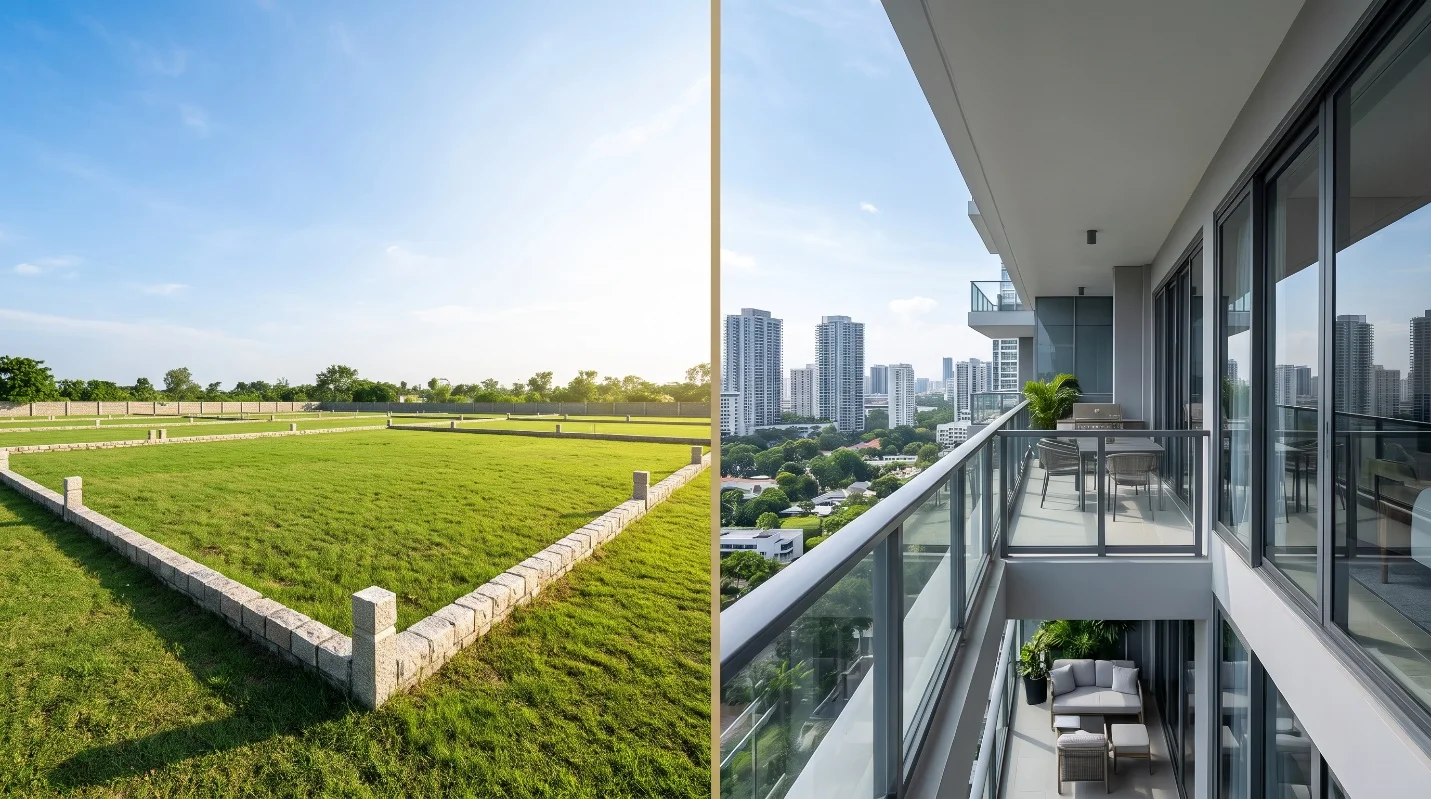
If you have ever sat across a real estate broker's desk in Bengaluru trying to decide where to put your savings, you have probably heard some version of the same debate. One side tells you an apartment is the "practical" choice - ready to move in, easy to rent out, no construction headaches. The other side insists that land is where real wealth is quietly built, and that anyone who has watched a plot in the right location triple in value over a decade will tell you the same thing.
Both sides have a point. But “which is better” is the wrong question to start with, because land and apartments are not really competing products. They are two different financial instruments that happen to both be called real estate. One is built to appreciate. The other is built to be lived in and, secondarily, to appreciate. Understanding that distinction is the real starting point for anyone trying to build long-term wealth through property in a city like Bengaluru.
This guide walks through the economics of both options - how each one creates value, what eats into your returns, what the historical patterns suggest, and how to think about which one fits your goals - so you can approach the decision with more than a broker's opinion to go on.
The Core Difference: What You Are Actually Buying
When you buy an apartment, you are buying two things bundled together: a share of land (through undivided share, or UDS) and a structure built on top of it. The structure - the walls, the plumbing, the electrical wiring, the lift, the paint - begins depreciating the moment it is built, the same way a car loses value the day you drive it out of the showroom. Depreciation on the built-up portion is a real, measurable drag on your asset's value over time, even in a rising market.
When you buy a plot of land, you are buying only one thing: the land itself. There is no structure to depreciate, no lift to service, no waterproofing to redo every eight years. What you own is the ground, and the ground is finite. Bengaluru is not manufacturing more of it. Every year the city adds residents, expands its urban footprint, and pushes further into what used to be its outskirts - and every year, the supply of usable, well-located land in that path of growth shrinks a little more. That scarcity is the entire engine behind long-term land appreciation.
This is why seasoned investors often say that land appreciates while buildings depreciate. It sounds like a slogan, but it is really just an accounting truth. An apartment's value is a blend of appreciating land and depreciating structure - and depending on the age of the building, the depreciation can start to outweigh the appreciation, especially once a building crosses 15 to 20 years and starts needing major structural repairs, re-wiring, or plumbing overhauls that ultimately fall on the owners' shoulders through special maintenance assessments.
How Appreciation Actually Plays Out
To understand why plots and apartments behave so differently over a ten- or fifteen-year horizon, it helps to look at where the appreciation is coming from in each case.
- Apartment appreciation is driven primarily by location and, to a lesser extent, by amenities and brand. Because a large share of the price is for the concrete structure, appreciation tends to be front-loaded - strongest in the first five to eight years after possession, while surrounding infrastructure is still maturing - and it tends to flatten or even decline in real terms once a building starts showing its age relative to newer projects nearby.
- Land appreciation tends to be back-loaded and compounding. In the early years after a plotted development is launched, prices may move slowly while roads, water lines, schools and hospitals are still being built out around it - which is precisely the window in which land is cheapest relative to where it is headed. As the corridor matures, land values tend to accelerate rather than plateau, because the land itself never ages out of relevance.
This is a big part of why corridors on the outskirts of fast-growing Indian cities - the Sarjapur Roads, the Whitefields, the Electronic City extensions of a decade or two ago - have produced some of the most dramatic land value stories in Bengaluru's real estate history. Early investors who bought approved, plotted land in these areas before the infrastructure caught up often saw returns that no apartment in the same period could match, precisely because they were capturing the entire arc of a corridor's transformation from peripheral to prime.
The Control Factor: Building on Your Own Terms
There is a less-discussed but genuinely important dimension to this comparison: control.
When you buy an apartment, you are buying someone else's design decisions - the floor plan, ceiling height, bedroom count, and fittings were all decided by a developer, often years before you walked through the show flat. You can renovate within the four walls you're given, but you cannot change the footprint or the structure.
A residential plot flips this entirely. You decide when to build, how to build, and what to build - a ground-floor room for aging parents, a home office with independent access, a larger kitchen, a private garden, a layout suited precisely to how your family lives. You can build in phases as finances allow, something simply not possible with an apartment. For many buyers, this freedom to design a home around their life - rather than adjusting their life to fit a home - is worth as much as the financial upside.
A plot also gives you optionality an apartment doesn't: build immediately, wait and build once the area has matured further, or hold the land purely as an investment and sell it later without ever constructing anything. An apartment, by contrast, is a finished decision from day one.
The Honest Case for Apartments
None of this means apartments are a poor choice - they solve a different problem. If your priority is immediate liveability, an apartment wins decisively: you move in, you live, and you don't manage a multi-year construction project. For a young professional buying their first home, or a family needing to move in within months, an apartment is often the only realistic option.
Apartments also tend to offer better rental yields relative to price in the short-to-medium term, since they are immediately habitable and there is a large, active rental market near IT corridors and business districts. If your primary goal is monthly rental income rather than long-term capital appreciation, a well-located apartment can generate cash flow that a vacant plot - which produces no rent until something is built on it - simply cannot.
Gated apartment complexes also bundle security, maintenance and amenities into a shared, professionally managed service. You pay for this through maintenance charges, but you are outsourcing the management burden rather than carrying it yourself.
The honest comparison, then, is this: apartments are optimized for convenience, immediate use, and rental cash flow. Land is optimized for long-term capital appreciation and future flexibility. A financial plan that only accounts for one of these is incomplete.
The Cost Side Nobody Talks About
Discussions about property investment tend to focus entirely on purchase price and eventual sale price, quietly skipping over everything that happens in between. This is where the two asset classes diverge sharply.
- Apartments carry ongoing costs that compound over time - monthly maintenance charges, sinking fund contributions, periodic special assessments for major repairs, and the eventual cost of renovation once fittings, plumbing and wiring age past their useful life. A twenty-year-old apartment often needs capital expenditure that meaningfully eats into whatever appreciation has occurred.
- A vacant residential plot has minimal carrying costs by comparison - property tax on undeveloped land is typically far lower than on a constructed apartment of similar value, and there's no lift or plumbing to maintain. A well-planned gated plotted community may charge a modest fee for shared infrastructure, but it's generally a fraction of an apartment complex's maintenance bill, since there's no building to maintain.
This difference becomes especially significant over a ten-to-twenty-year holding period - the timeframe over which real wealth in real estate is typically built. Over two decades, cumulative maintenance and renovation costs on an apartment can add up to a substantial fraction of the original purchase price, whereas equivalent costs on a plot remain comparatively negligible.
Liquidity and Exit: Where Land Loses Some Ground
It would be dishonest to write about land as though it has no drawbacks, and the most legitimate one is liquidity. Apartments, particularly in established, well-connected micro-markets, tend to have a larger and more active pool of buyers, since demand includes both investors and end-users who need a home right now - which generally makes them easier to sell quickly.
Land, especially larger or higher-value plots, can take longer to sell because the buyer pool is somewhat narrower. This is a real consideration if you anticipate needing to liquidate on short notice.
That said, this gap narrows considerably in well-planned, professionally developed plotted communities with clear titles, proper approvals, and strong connectivity, where demand from both investors and end-users planning to build has grown substantially. The liquidity gap is far more pronounced with poorly documented, isolated agricultural or unapproved land - a separate and much riskier category worth avoiding regardless of your investment horizon.
The Approval and Documentation Question
This is a good moment to address the single biggest reason people hesitate on land: the fear of legal complications. It's a legitimate concern, but a manageable one if you know what to check.
The key is distinguishing between raw, undocumented land and approved, plotted development. A plot within a project approved by the relevant planning authority - around Bengaluru, this typically means BMRDA or BDA approval - comes with a defined layout, sanctioned roads, allocated open spaces, and a clear regulatory framework. This is a fundamentally different, and far safer, proposition than buying an unapproved agricultural parcel and hoping to convert it later.
Before buying any plot, a buyer should verify:
- The layout's approval status with the relevant development authority
- A clear and marketable title, verified through an Encumbrance Certificate (EC) covering at least 15 to 30 years
- Khata status (or E-Khata, the digital property record used in Karnataka), confirming the property is properly recorded for tax and legal purposes
- That the land is not under any litigation, acquisition notice, or government reservation
- Conversion status, confirming agricultural land has been legally converted to non-agricultural (residential) use where applicable
Buyers going through an established, reputed developer with a track record of delivering approved, documented plotted developments largely sidestep these risks, since the due diligence has already been done at the project level. This is precisely why the “which is riskier” conversation should really be reframed as “how do you choose a credible seller,” rather than “land is inherently risky.” The risk lives in the documentation, not in the asset class itself.
Financing: A Real Practical Difference
One area where apartments currently have a structural advantage is home loan accessibility. Most banks offer loans for apartment purchases fairly liberally - often up to 80–90% of the property value - because the collateral is an immediately valued, constructed asset with an active resale market.
Loans for plot purchases are available too, but tend to come with somewhat lower loan-to-value ratios and, in many cases, a requirement that construction begin within a defined period after purchase, since banks are generally more comfortable financing land when there's a clear plan to build on it. This isn't a dealbreaker, but plot buyers should go in with a clearer financing plan - ideally a larger share of self-funded capital, or a composite loan structured for plot-plus-construction.
A Practical Framework: How to Decide
Rather than treating this as a binary choice, it helps to ask a few honest questions about your own situation.
- What is your time horizon? For value within three to five years, an apartment's better liquidity and faster early appreciation may serve you better. For a ten-to-twenty-year horizon, land's back-loaded, compounding curve tends to reward patience disproportionately.
- Do you need income now, or growth later? If you need immediate rental income, an apartment fits more naturally. If you can let the asset simply appreciate, land carries lower ongoing costs and a stronger long-term profile.
- Do you eventually want to build a custom home? If there's any real possibility of designing a home suited to your specific needs, buying a plot now — even years before you plan to build — locks in land value while preserving complete design freedom.
- How much involvement do you want in construction? Building a home is a multi-year process involving architects, contractors and constant decisions. If that isn't something you want to manage personally, factor the cost of a turnkey construction service into your plot plan from the outset.
- What's your risk tolerance around liquidity? If you might need to sell quickly and unpredictably, mitigate this by choosing well-located, well-documented plots in active, in-demand corridors, where the liquidity gap with apartments is smallest.
Why South Bengaluru's Growth Corridors Matter to This Decision
This conversation becomes more concrete when you look at where Bengaluru's growth is actually heading. The city's southern peripheries - corridors like Kanakapura Road and its surrounding micro-markets - are following a pattern that eastern corridors like Sarjapur Road and Whitefield went through fifteen to twenty years ago: initially quieter and more affordable, then gradually absorbed into the city's expanding infrastructure network as roads widen, connectivity improves, and schools, hospitals and retail fill in around it.
This is precisely the phase in a corridor's life cycle where land offers its strongest long-term upside, because you are buying before the bulk of the appreciation has been priced in, rather than after. Investors who understand this timing - buying approved, well-documented plots in a growth corridor early, and holding through the maturation cycle - are positioned to capture the kind of long-run appreciation that ready apartments in already-mature markets typically cannot replicate.
The Bottom Line
Land and apartments are not really rivals competing for the same rupee - they are two different tools for two different jobs. An apartment gives you immediate liveability, easier financing, stronger rental cash flow, and simpler liquidity. A plot gives you lower carrying costs, design freedom, a stronger long-term compounding curve, and the ability to time your entry into a growth corridor before the bulk of its appreciation has occurred.
For long-term wealth building specifically - the kind of horizon where you're thinking in decades, not years - the economics tend to favour land, provided it is properly approved, clearly titled, and located in a genuine growth corridor rather than a speculative or unapproved parcel. The right answer ultimately depends on what you're optimizing for, but if the goal is genuinely long-term wealth with minimal erosion from maintenance costs along the way, a well-documented plot in a well-chosen location gives you a foundation, quite literally, to build that wealth on your own terms.
Making the Decision Easier
Whichever way you lean, the decision is easier when the underlying asset removes the guesswork - clear approvals, a transparent title, and a developer willing to walk you through the documentation rather than just the brochure.
If you're weighing a long-term investment in South Bengaluru, Amidst Nature offers approved, well-documented plots in a corridor still early in its growth curve - giving you the appreciation potential of land with the design freedom to build your own home on your own timeline.