


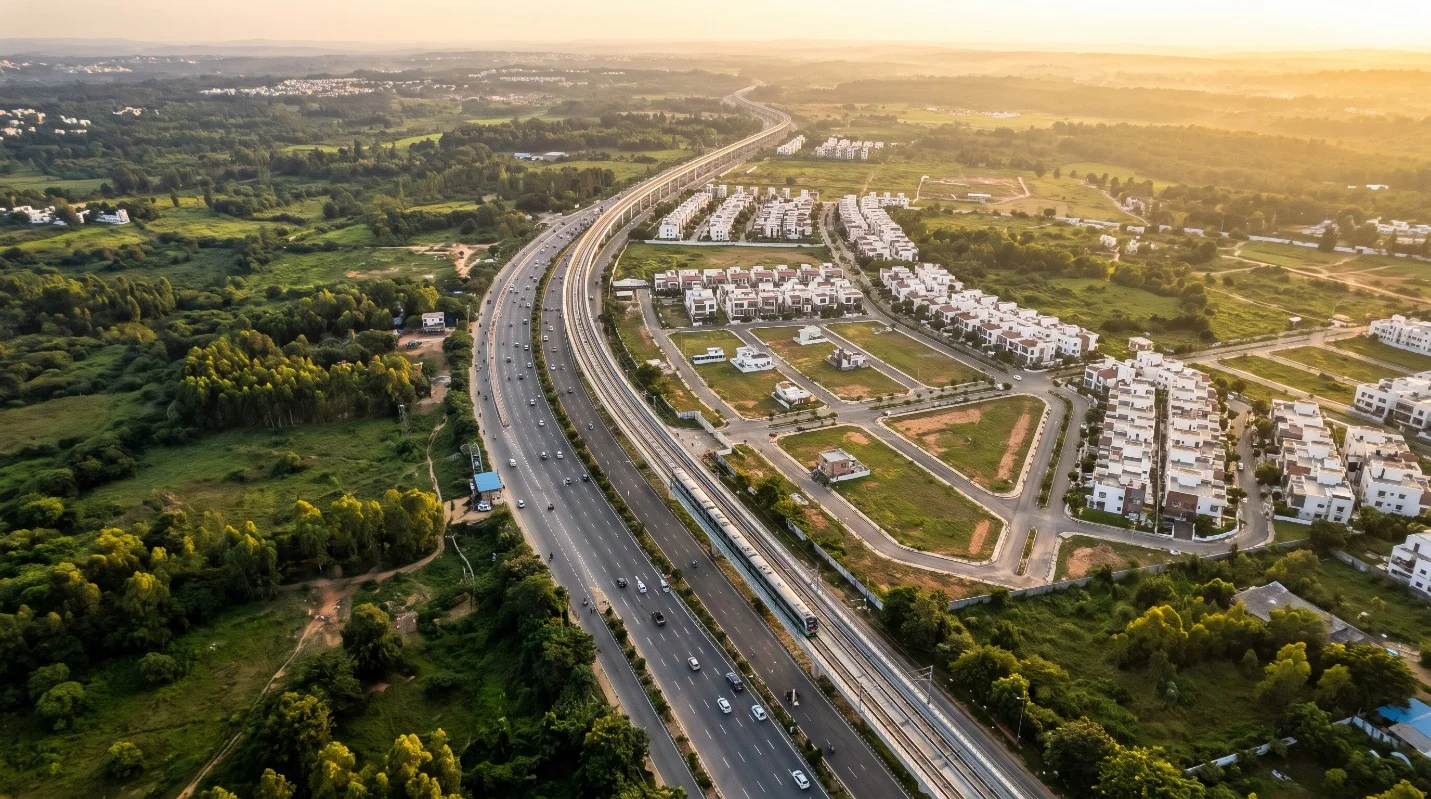
Every growing city has a handful of roads that quietly turn from afterthoughts into addresses. Bangalore has seen this happen before - Sarjapur Road was once considered too far out to bother with, Whitefield was a sleepy suburb best known for its parsi colony and a few factories, and Electronic City's extension roads were dismissed as too remote for anyone but IT commuters willing to make a long drive. All three are now among the city's most sought-after, and most expensive, residential corridors.
Kanakapura Road is now being watched for the same reason. It isn't a new discovery - the road itself has existed for decades, connecting Bangalore to the pilgrimage town of Kanakapura and onward toward the state's southern districts. What has changed is everything around it: the pace of infrastructure investment, the shift in what buyers are looking for, and the simple fact that South Bangalore has comparatively more open, developable land left than the city's more saturated eastern corridors.
This piece looks at what's actually driving the shift, what the data and infrastructure pipeline suggest about where this corridor is headed, and why it's increasingly showing up on the radar of both end-users and long-term investors.
A Familiar Pattern, Playing Out Again
It's worth pausing on why this pattern - a peripheral road quietly becoming a prime address - keeps repeating itself in growing cities, because understanding the mechanism helps you judge whether Kanakapura Road genuinely fits it, rather than taking the comparison on faith.
The pattern typically has three ingredients: a large and growing employment base within commuting distance, land that is still available in meaningful quantities rather than already built out, and a government infrastructure pipeline that is actively investing in the corridor rather than treating it as an afterthought. When all three are present simultaneously, prices tend to move in a predictable arc, i.e., slow and largely investor-driven in the early years, followed by a period of accelerating end-user demand as connectivity and social infrastructure mature, followed eventually by a plateau once the corridor is largely built out and priced accordingly.
Sarjapur Road and Whitefield both moved through this arc over roughly a decade and a half. The question worth asking about Kanakapura Road isn't whether it will follow exactly the same trajectory, as no two corridors are identical, but whether the same underlying ingredients are genuinely present. The sections below look at each of them in turn.
Where Kanakapura Road Actually Sits
Kanakapura Road runs southwest from Bangalore, starting near the Kirloskar/Basavanagudi ring and extending outward through Konanakunte, Anjanapura, JP Nagar's outer extensions, Thalaghattapura, Kaggalipura, and further toward Harohalli and Kanakapura town itself. For residents working in South Bangalore's established employment hubs - the Bannerghatta Road tech corridor, Electronic City, the JP Nagar and Banashankari commercial belt, and increasingly the upcoming aerospace and industrial clusters further south - this puts a meaningfully large employment base within a manageable daily commute.
This matters because one of the most consistent predictors of which corridor grows next in any city is simple: proximity to where people already work, combined with land that hasn't yet been built out to capacity. Kanakapura Road checks both boxes in a way that few of Bangalore's other peripheral roads currently do.
The Infrastructure Pipeline Driving the Shift
Infrastructure is almost always the single biggest lever behind a corridor's transformation, and Kanakapura Road has several projects either underway or in active planning that are collectively reshaping its accessibility.
- Namma Metro's Yellow Line and future extensions have brought rail-based connectivity meaningfully closer to South Bangalore than it has ever been, easing the commute for residents along this corridor into the city's core and its major employment nodes.
- Road widening and junction improvements along Kanakapura Road itself have been an ongoing focus for civic authorities, aimed at easing what has historically been a bottleneck during peak hours as traffic volumes have grown faster than the road's original capacity.
- The Peripheral Ring Road (PRR) and connecting arterial roads, once completed, are expected to significantly improve east-west connectivity across Bangalore's outer ring, reducing dependence on the congested core for residents living along southern and southwestern corridors like this one.
- NICE Road connectivity already gives Kanakapura Road residents a faster route toward Mysore Road, Electronic City, and other parts of the outer ring, without needing to pass through central Bangalore's traffic at all.
None of these projects are unique to Kanakapura Road as Bangalore is investing in infrastructure across many of its growth corridors simultaneously. What matters is that this particular corridor is benefiting from several of these projects converging in the same stretch of the city, at a point in its development cycle where land is still considerably more affordable than in corridors where similar infrastructure arrived years ago.
It's also worth being realistic about timelines. Large infrastructure projects in any Indian city are prone to delays, and the Peripheral Ring Road in particular has been through multiple rounds of planning revisions over the years. The sensible approach for a buyer isn't to price in every planned project as though it will land exactly on schedule, but to recognize that the direction of investment is clear and sustained, even if individual milestones shift by a year or two along the way.
Why Land Availability Still Matters Here
Much of Bangalore's eastern growth corridors - Whitefield, Sarjapur Road, Electronic City - have reached a point where large, contiguous parcels of developable land are increasingly scarce, pushing prices upward and shifting new development toward smaller infill plots and high-rise construction. South Bangalore, and Kanakapura Road in particular, still has meaningfully more open land in its immediate vicinity, giving developers room to plan larger, better-designed layouts with genuine open space, rather than maximizing density on constrained parcels.
This distinction matters more than it might initially seem. A corridor that still has room for well-planned, spacious layouts such as wide roads, generous plot sizes, and dedicated green spaces, offers a fundamentally different buying experience than one where every new project is a response to shrinking, expensive land. For buyers specifically seeking villa plots or larger-format homes rather than high-density apartments, this is one of the clearest reasons South Bangalore, and this corridor specifically, has become a focus of attention.
Social Infrastructure Is Catching Up Quickly
Roads and metro lines get most of the attention, but a corridor doesn't become genuinely livable until schools, hospitals, and retail follow. This is exactly the phase Kanakapura Road is currently in. The stretch already has a growing base of reputed schools, established hospitals in and around JP Nagar and Banashankari feeding into the corridor, and a steadily expanding retail and dining footprint that has moved well beyond the handful of standalone shops that once defined the area.
This is also, historically, the phase in a corridor's life cycle where land tends to offer its strongest long-term upside, when social infrastructure is developed enough to make daily life genuinely convenient, but land values haven't yet caught up to reflect that convenience. Corridors that have already “arrived,” by contrast, tend to have this improvement in convenience already priced into their land values.
Retail, in particular, tends to be a useful barometer of a corridor's trajectory, because unlike government infrastructure projects, retail investment is almost entirely demand-driven like how a supermarket chain or a restaurant group doesn't commit to a location unless the footfall and spending power already justify it. The steady arrival of organized retail along Kanakapura Road over the past several years is, in that sense, a market signal as much as a convenience.
Who Is Actually Buying Along This Corridor
The buyer profile along Kanakapura Road has shifted noticeably over the last several years. Early interest came predominantly from long-term investors willing to bet on a corridor before its infrastructure had matured. That's changed as the area's livability has improved. A growing share of buyers today are genuine end-users: families relocating from denser parts of Bangalore in search of more space, professionals working in South Bangalore's tech and industrial hubs who want a shorter commute, and a meaningful number of NRI buyers drawn to the corridor's combination of relative affordability, planned development, and long-term appreciation potential.
This shift from a predominantly investor-driven market to one with genuine end-user demand is itself a healthy signal. Corridors sustained purely by speculative investment tend to see sharp price swings and can stall if investor sentiment shifts; corridors with a growing base of people who actually want to live there tend to see steadier, more durable demand over time.
NRI interest specifically has picked up along this corridor in recent years, driven by a combination of factors: comparatively lower entry prices than more established corridors, a growing number of professionally managed, well-documented plotted developments that make remote due diligence more feasible, and South Bangalore's broader reputation for a quieter, greener living environment - something that resonates strongly with NRI buyers planning for an eventual return to India or a long-term family home rather than a purely speculative purchase.
How Kanakapura Road Compares to Bannerghatta Road
Bannerghatta Road is often the first comparison buyers make, since it runs roughly parallel to Kanakapura Road and serves a similar catchment of South Bangalore's employment hubs. The two corridors are more complementary than competing, though, and the differences are worth understanding rather than glossing over.
Bannerghatta Road is considerably more built-out at this point, with a longer history of both commercial and residential development, and correspondingly higher land prices as a result, much of its appreciation curve has already played out. It also tends to carry heavier traffic congestion, given its role as a primary commercial and IT corridor in its own right, with several large tech campuses and hospitals along its length.
Kanakapura Road, running further west, has developed somewhat later and currently offers more available land and a comparatively less congested, lower-density character. For buyers specifically prioritizing villa plots and larger-format living over apartment density, this makes Kanakapura Road the more natural fit today, even though both corridors serve an overlapping set of daily needs for South Bangalore residents.
The Shift Toward Villa Plots Over High-Density Apartments
South Bangalore more broadly, and Kanakapura Road specifically, has also benefited from a noticeable shift in buyer preference away from high-density apartment living. Years of increasingly compact apartment layouts, rising maintenance costs in older high-rises, and a renewed appreciation for private outdoor space - accelerated in part by changing lifestyle priorities in recent years - have pushed a segment of buyers toward villa plots and low-density gated communities instead.
Kanakapura Road, with its relatively larger available land parcels, has become one of the natural beneficiaries of this shift, hosting a growing number of plotted developments and villa communities designed specifically around lower density, larger plot sizes, and genuine green space; a very different value proposition from the high-rise apartment towers that dominate much of Bangalore's more built-out corridors.
Micro-Locations Within the Corridor
Kanakapura Road isn't a single, uniform market. It's a long corridor with distinct micro-locations at different stages of development. Areas closer to the city, like Konanakunte and JP Nagar's outer phases, are already well-established and priced accordingly. Further out, stretches like Thalaghattapura and Kaggalipura are earlier in their development curve, offering a combination of improving infrastructure and comparatively more affordable land, which is precisely why this stretch has drawn increasing attention from both developers and long-term investors looking for the kind of early-corridor entry point that Sarjapur Road or Whitefield once offered.
Further south still, toward Harohalli and Kanakapura town, the corridor is earlier-stage yet, with infrastructure and social amenities still catching up, an area to watch over a longer time horizon, but one that currently suits a more patient, speculative kind of investment than the stretches closer to the city.
What to Watch Before Investing in This Corridor
- Layout approval status - as the corridor attracts more development activity, verifying BMRDA or BDA approval for any specific plotted development remains just as essential here as anywhere else in Bangalore.
- Specific infrastructure timelines - metro extensions, PRR completion dates, and road-widening projects are all subject to delays; a realistic timeline, rather than an optimistic one, should inform your investment horizon.
- Micro-location within the corridor - given how much variation exists along its length, treat “Kanakapura Road” as a broad direction rather than a single, homogenous market, and evaluate the specific stretch on its own merits.
- Developer track record - as any growth corridor attracts more players, verifying a developer's history of delivering approved, well-documented layouts becomes an increasingly important filter.
- Realistic exit expectations - an early-stage corridor rewards patience more than urgency; buyers expecting rapid, short-term appreciation should recalibrate toward the longer, multi-year timeline these corridors typically follow.
The Bottom Line
Kanakapura Road's emergence isn't the result of a single announcement or a single project - it's the product of several things happening at once: meaningful infrastructure investment, comparatively abundant land in a city where that's increasingly rare, social infrastructure that has matured faster than land prices have caught up to reflect, and a genuine shift in buyer preference toward more spacious, lower-density living.
Corridors like this don't stay early-stage indefinitely. The same pattern that took Sarjapur Road and Whitefield from peripheral to prime over a decade or two is visibly underway here, at an earlier and more accessible point in the cycle. For buyers thinking in a genuinely long-term horizon, rather than looking for a quick flip, that timing is precisely the opportunity worth paying attention to.
The most useful mental model is probably this: Kanakapura Road today occupies roughly the position Sarjapur Road occupied ten to fifteen years ago - not identical in every respect, but similar enough in its combination of employment proximity, available land, and active infrastructure investment that the comparison is more than just marketing shorthand. What happens from here depends on execution, on infrastructure projects actually being delivered, and on development along the corridor staying disciplined about approvals and planning quality rather than chasing short-term volume. Both of those are reasonable things for a prospective buyer to watch closely, rather than simply assume.
Exploring the Corridor Firsthand
Numbers and infrastructure timelines only tell part of the story. The rest is best understood by actually spending time along the corridor, seeing which stretches feel established and which still feel early, and getting a sense of the pace of change on the ground.
Amidst Nature is located in Kaggalipura, along this corridor's earlier-stage stretch, offering approved, well-documented villa plots in a location positioned to benefit from the infrastructure and social development still unfolding around it. Visiting the corridor firsthand, on a weekday and a weekend, and speaking with residents already living there, tends to tell you more about its actual trajectory than any single article can.
This article is for general informational purposes and does not constitute investment advice. Prospective buyers should independently verify infrastructure timelines, approvals, and market conditions before making a purchase decision.